New! Introducing Claret’s ✦ AI Assistant! Learn more

Resources

Beverage alcohol supply chain ROI calculator

Your team spends hours wrestling spreadsheets, reconciling forecasts, and managing stockouts. But what's the real cost? This calculator estimates the annual value of replacing manual planning with a platform built for wine and spirits companies. Enter a few numbers about your operation, and you'll see where the savings are.

Takes less than two minutes to complete.

Your data stays private. We don't share or store your inputs.

Approximate number of cases shipped per year.

Approximate number of active SKUs you regularly plan or forecast.

Sales team members whose forecasts or inputs affect demand planning.

How your team primarily plans demand, inventory, or supply today.

Calculate savings

Please complete all fields before calculating.

Estimated annual savings

$0

Based on industry benchmarks and your inputs.

See your full savings breakdown

Category-by-category breakdown (inventory, productivity, stockouts)

Key assumptions behind the estimate

Strategic insights for your board conversation

We'll also send you relevant planning insights over the next few days. Unsubscribe anytime.

Closed the breakdown?

View your analysis again →
Thank you! Your submission has been received!
Oops! Something went wrong while submitting the form.
What you'll get
ROI calculator for BevAlc
Put a dollar value on the planning gap
Most wine and spirits companies carry 10–30% more inventory than they need and lose revenue to preventable stockouts. This calculator shows you exactly what those gaps cost your business each year.
Build the business case your board needs
Finance teams and leadership don't approve investments based on gut feel. Get a clear, quantified estimate you can bring to your next budget conversation, broken down by inventory savings, labor efficiency, and service level improvements.
See which area of your operation has the most to gain
The calculator breaks your results into three categories: inventory carrying costs, team productivity, and stockout prevention. You'll know where to focus first and what to prioritize in vendor conversations.
How it works

Enter a few details about your operation: annual case volume, number of SKUs, team size, and how you plan today. Then share your current inventory costs, time spent on demand planning and forecasting, and stockout frequency.

The calculator uses industry benchmarks from beverage alcohol companies to estimate savings across three areas: inventory carrying costs, planning efficiency, and service level improvements. You'll see a total annual value and a breakdown of where that value comes from.

Estimated annual savings

This represents the projected annual financial impact of improving supply chain planning performance in your beverage alcohol operation.
Inventory reduction:
Lower carrying costs through better demand visibility
Planning productivity gains:
Time recovered from automated planning workflows
Reduced stockouts:
Revenue protected by improved forecast accuracy
These projections use conservative, industry-informed assumptions. Many companies exceed these baseline improvements within the first 12 months.
Scroll down to read the full analysis. Or, if you'd like to talk it through or save it for later:

Why this value exists

Beverage alcohol is structurally complex. You are balancing agricultural lead times, vintage transitions, seasonal demand patterns, allocation dynamics, and three tier distribution constraints. Decisions made today often surface financially months later, sometimes when it is too late to correct course.
In this environment, small forecasting errors do not stay contained. They ripple across production, distributor inventory, and market performance.
Excess inventory ties up capital. Planning friction consumes executive bandwidth. Stockouts damage relationships that take years to build.
  • Excess inventory ties up capital.
  • Planning friction consumes executive bandwidth.
  • Stockouts damage relationships that take years to build.
The projected value above reflects what happens when those ripple effects are reduced. This is not about perfection. It is about control.

The inventory story

Inventory in BevAlc is not just product waiting to ship. It represents cash tied up in bulk wine, aging barrels, packaging materials, and finished goods sitting in warehouses or at distributors.
When visibility improves, excess inventory contracts naturally. Production aligns more closely with demand. Vintage transitions become smoother. Working capital improves.
The impact is felt directly on the balance sheet. For many operators, this is the most immediate financial lever available.
Cellar inventory

The productivity shift

Planning teams are typically lean, yet the portfolio continues to grow. More SKUs, more distributors, more channels. Complexity expands faster than headcount.
Without structure, time is consumed reconciling spreadsheets, chasing versions, and validating numbers instead of anticipating risk.
When workflows become integrated, that time is redirected. Planners spend less effort consolidating data and more effort shaping outcomes.
The result is fewer surprises and stronger execution.

The revenue protection layer

In a three tier system, reliability is currency. A stockout does not just reduce a single order. It can affect shelf placement, distributor confidence, and competitive positioning. Recovering lost placements often requires far more effort than maintaining them.
Improved forecast reliability reduces volatility. Reduced volatility protects placement. Protected placement sustains revenue.
Stockout prevention is about preserving momentum.
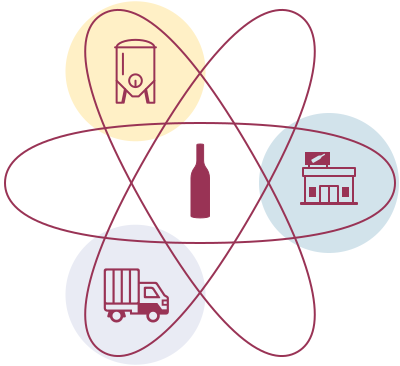
Diagram showing BevAlc's 3-tier network

Built for executive scrutiny

This estimate applies conservative improvement ranges across the three financial drivers above. It is designed to withstand internal review.
Even modest improvements in inventory efficiency, productivity, and forecast reliability compound into meaningful annual impact.
Actual results depend on implementation discipline and alignment across teams. The projections reflect achievable performance gains, not aggressive transformation assumptions.

Framing the internal discussion

When presenting this internally, focus on exposure and control.
  • Excess inventory ties up capital.
  • Planning friction consumes executive bandwidth.
  • Stockouts damage relationships that take years to build.
The projected annual value is not hypothetical upside. It represents risk currently embedded in the operating model.
Boards respond to clarity, conservative modeling, and defined accountability. The structure of this analysis is meant to support that level of conversation.

Choosing the right path forward

Any planning solution in BevAlc must understand vintages, allocations, distributor inventory layers, and long material lead times. Generic supply chain tools often struggle with those realities because they were not built for this industry’s structural complexity.
The goal is not to add another system. It is to create alignment between sales forecasts, inventory strategy, and supply decisions in a way that reduces uncertainty across the organization.
This is where a BevAlc focused planning platform becomes critical.
Claret was built specifically for beverage alcohol operators facing these exact challenges. Instead of adapting a generalized planning tool, it provides an integrated environment designed around BevAlc data structures, workflows, and constraints. The result is faster visibility, more confident execution, and measurable financial impact across inventory, productivity, and revenue protection.
If the projected value above represents meaningful exposure in your business, the next step is to validate whether a BevAlc focused planning platform can realistically unlock it.

Next step

The most effective next step is a focused conversation. In 30 minutes, we can walk through these projections in detail, align the assumptions with your operating model, and outline what a realistic path forward looks like.
This is not a product pitch. It is a conversation about whether the numbers hold up for your business.
You can book a call directly at claret.app, or reach us at hi@claret.app. We're happy to start with a quick email if that's easier.
Or, if you'd like to save this analysis or talk it through:
Close button