Smarter supply planning that respects your inventory strategy
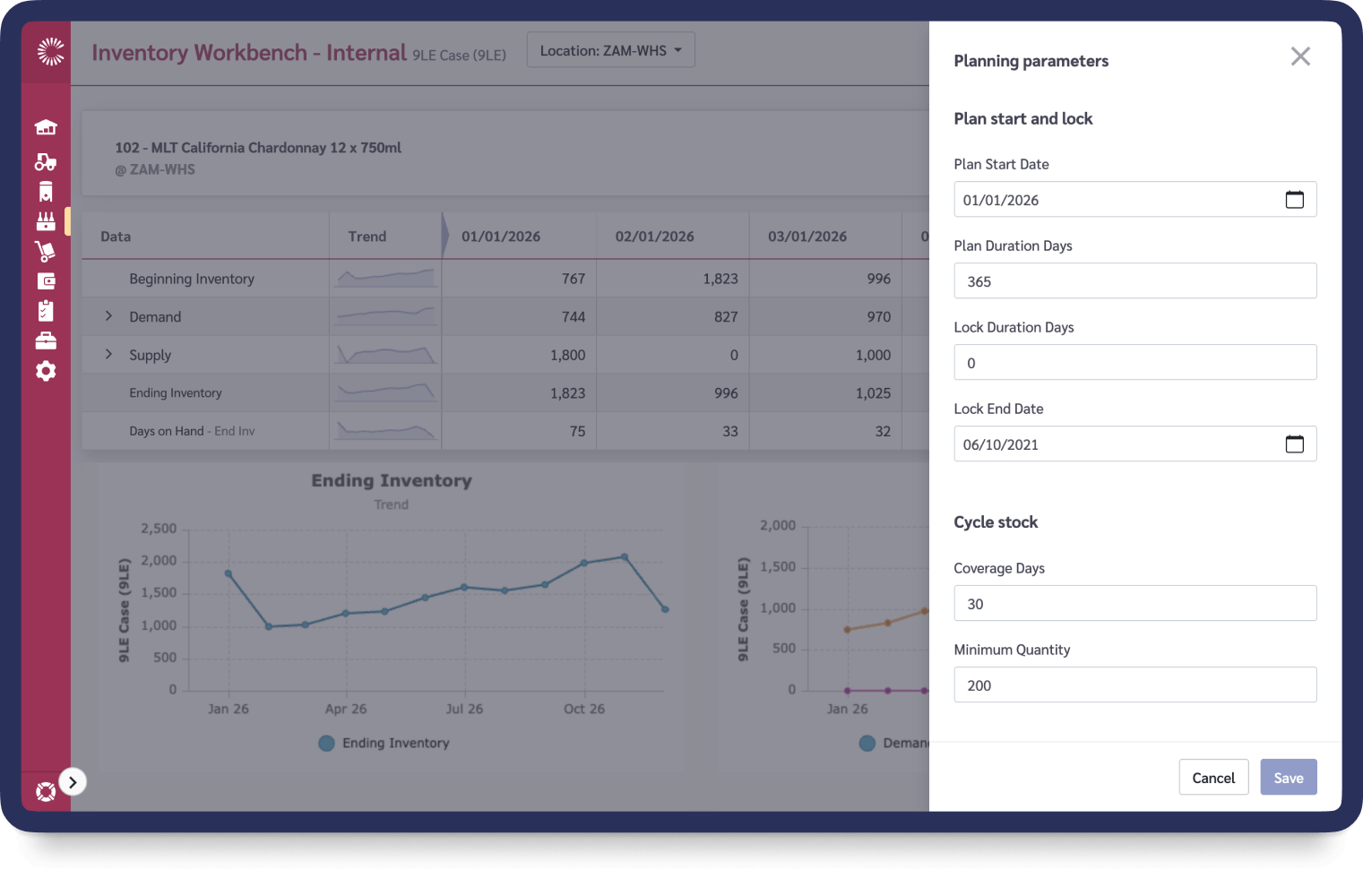
Your inventory decisions shouldn't rely on gut instinct and last year's numbers. This year we added integrated supply planning directly into the Inventory Workbench.
What does that mean in practice? You now have an algorithm that helps automate bottling plans while respecting your company's inventory strategy. No more building plans from scratch or hoping the numbers work out. We also added batch supply plan generation, so you can create plans across your entire portfolio instead of clicking through item by item.
We heard from users that they needed more flexibility in how they view inventory data. Now you can toggle between days, weeks, or months depending on whether you're planning for tomorrow's shipment or next quarter's production run.

Sales collaboration that doesn't slow you down
The Sales Collaboration module is where many of your team members spend their day. This year we made it faster.
We optimized query caching, increased database buffer sizes, and fixed the small annoyances that add up over time: infinite spinners, reconciliation errors that were hard to diagnose, and number formatting that looked different in edit mode versus view mode.
The goal wasn't to add flashy features. It was to make the tool you already depend on work better. When your sales team can reconcile forecasts without waiting, that's time they get back to sell.

APIs that let you connect everything
Your tech stack isn't just Claret. You have ERP systems, data warehouses, BI tools, and custom integrations that make your business run. We expanded our public APIs significantly this year to make those connections easier.
New endpoints let you pull planning data programmatically, and the inventory endpoint now accepts JSON payloads in addition to CSV uploads. For operations teams managing complex integrations, these aren't nice-to-haves. They're the difference between a manual workaround and an automated workflow.

The infrastructure you don't see (but definitely feel)
Some of the most important work we did this year is invisible. We upgraded core systems across the platform for better reliability and faster performance. We also made changes to improve privacy and GDPR compliance, because your data protection matters even in the details.
On the onboarding side, we overhauled tenant provisioning so new customers get up and running with all the master data they need from day one.

Subscription management that works for you
As Claret grows, we've built out the infrastructure to support different pricing tiers and subscription models. Our new billing integration handles license checking and subscription management. We added an in-app pricing page and automated welcome emails and invoicing.
This matters because it means less back-and-forth when you're evaluating Claret or managing your account. Self-service where it makes sense, with human support when you need it.

A new way to think about pricing
Pricing in beverage alcohol is complicated. You're juggling distributor contracts, allocation strategies, vintage variations, and market-specific deals. Most planning tools treat price as a static field. We know better.
This year we launched Price Designer, a new module built specifically for the way wine and spirits companies actually price their products. It handles dynamic contract allocation pricing, so you can model complex scenarios without exporting to a spreadsheet and hoping your formulas don't break.
For teams managing multiple price lists across regions or channels, this means fewer manual updates and more time spent on strategy instead of data entry.

What this adds up to
Sixty releases might sound like a lot, but each one represents a specific problem we heard about and decided to solve. We're not building features to check boxes on a comparison chart. We're building for the beverage alcohol leaders who are tired of wrestling with tools that weren't made for them.
If your current planning process involves too many spreadsheets, too much manual reconciliation, or software that treats your business like a generic widget manufacturer, we should talk.
Because at the end of the day, you shouldn't have to force-fit your business into someone else's software. Your planning tools should understand that a 2022 Cabernet Sauvignon from Napa Valley isn't the same as a 2023 Pinot Noir from Oregon. That inventory at a distributor warehouse moves differently than inventory in your own cellar. That pricing a new vintage requires context, not just a percentage increase.
That's the mission. Sixty releases down, and we're just getting started.

Frequently asked questions
1. What is Claret, and who is it built for?
2. What kind of problems does Claret solve?
3. Is Claret just a planning tool, or does it integrate with other systems?
4. What makes Claret different from generic supply chain software?
5. Can I try Claret before committing?